13 October 2026 · By MARX JAMES
Beyond the Canvas: Discovering the Working Life Behind the Art of Nick Fraser
An inspiring introduction to archiving at the London School of Economics reveals new historical perspectives on the industrial world surrounding East London outsider artist Nick Fraser.
A Journey into the Archives
Sometimes the most meaningful discoveries come when you're not quite sure what to expect.
On 13 October 2026, I had the privilege of attending an Introduction to Archiving course at the London School of Economics (LSE).
As I continue my journey to research, preserve and share the extraordinary artistic legacy of Nick Fraser, I have become increasingly aware of the responsibility that comes with caring for such a significant personal collection.
Nick's archive contains an extensive body of paintings, photographs and historical film footage documenting the life and creative expression of a working-class outsider artist from East London.
My ambition has always been to ensure that this collection is properly preserved, researched and made accessible to future generations.
Attending the course at LSE felt like an important step towards achieving that ambition.
What I hadn't anticipated, however, was just how much the experience would deepen my understanding of the historical world surrounding Nick's life.
I arrived eager to learn about archiving.
I left with a renewed appreciation of the extraordinary stories that historical documents can reveal, and perhaps most importantly, an even greater determination to continue the Nick Fraser Heritage Project.
Discovering the history behind a working life
For more than three decades, Nick Fraser worked at Tate & Lyle, one of the most recognisable names in Britain's sugar industry.
Alongside his industrial employment, he pursued his artistic expression, creating a remarkable collection of original paintings.
His story is one of working-class creativity, personal expression and the determination to make art outside the traditional structures of the established art world.
But to understand the artist, I increasingly believe we must also seek to understand the world in which he lived and worked.
During my visit to LSE, I explored historical material relating to Britain's sugar industry during the early 1970s.
Among the documents were company correspondence, parliamentary records, newspaper reports and publications examining the future of sugar refining following Britain's entry into the European Economic Community.
What initially seemed like a collection of historical business documents soon revealed something much more profound.
Behind the discussions of international trade agreements, sugar imports and government negotiations were the livelihoods of thousands of ordinary working people.
People whose families and communities depended upon the future of the industry.
It was a powerful reminder that industrial history is, ultimately, human history.
The uncertainty facing Britain's sugar workers
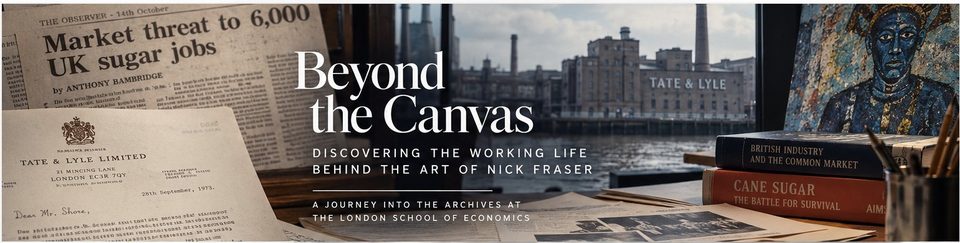
One particularly striking discovery was a letter dated 28 September 1973, written by John O. Lyle, chairman of Tate & Lyle.
Addressed to Mr Shore, apparently Peter Shore MP, the correspondence outlined serious concerns about the future of Britain's cane sugar-refining industry. The company warned that changes to the availability of raw sugar and the financial arrangements governing its refining operations could result in significant reductions in activity.
These were not minor concerns.
They raised the possibility of unemployment, financial insecurity and considerable hardship for employees.
Contemporary newspaper coverage reinforced the seriousness of the situation.
On 14 October 1973, The Observer published an article under the headline:
"Market threat to 6,000 UK sugar jobs"
The following day, The Guardian reported:
"Tate & Lyle face £9M loss on EEC issue"
Although these reports described potential consequences rather than outcomes that had already occurred, they provide a vivid picture of the uncertainty surrounding Britain's sugar industry at that moment in history.
Other documents describe the involvement of trade unions, Members of Parliament and campaigning organisations in efforts to influence government decisions. For workers and their families, the consequences of those negotiations could have been deeply personal.
It is precisely this human dimension that makes archival research so important.
Historical documents allow us to look beyond broad accounts of industrial change and begin understanding what was at stake for the people living through it.
East London and the people behind the industry
Among the material I examined was a document titled UK Sugar Industry in E.E.C.
The document records an estimated 7,550 people employed by Tate & Lyle Refineries across London, Liverpool and Greenock, including approximately 4,000 in London.
Another document, The Future of Cane Sugar, dated 18 July 1973, argued that the continued employment of 11,000 men and women across East London, Greenock and Liverpool depended upon maintaining supplies of Commonwealth cane sugar.
The different figures reflect the varying scope and purpose of the contemporary documents, but both reveal the scale of the employment interests under discussion.
These figures represent something far more meaningful than industrial statistics.
They represent thousands of individual lives.
Families, friendships, working relationships and communities connected through employment.
For decades, industrial workplaces played an important role in the everyday lives of people across East London.
Factories were places of hard work and routine, but also places where friendships developed, communities formed and generations of working people earned their living.
Nick Fraser's working life forms part of that wider history.
Although further research is needed to establish how particular events affected Nick personally, these records provide a valuable historical backdrop against which we can begin exploring his experiences.
And that is something I hope to investigate further.
A story that reaches far beyond East London
Another fascinating element of the archival material was the international history behind Britain's sugar industry.
Publications such as the World Development Movement's Cane Sugar: The Battle for Survival revealed the complex relationships connecting Britain's refineries to sugar-producing countries around the world.
The material explores the economic importance of sugar to developing countries, the legacy of colonial exploitation and slavery, and the international negotiations that shaped the industry's future.
It also reveals how changes in European agricultural and trade policy had consequences extending well beyond Britain.
These documents show that East London's industrial history cannot be understood entirely in isolation.
The sugar arriving at British refineries connected local employment to international communities, economies and generations of agricultural workers overseas.
This broader perspective provides another important dimension to understanding the historical environment surrounding Nick's working life.
It also illustrates why preserving industrial and working-class heritage is so valuable.
Behind the products, buildings and companies we recognise are complicated histories involving people, communities and international relationships.
The importance of preserving Nick Fraser's archive
As I continue working through Nick's collection, I find myself increasingly reflecting on a simple but important question.
How do we preserve not only the work of an artist, but also the story of the person who created it?
Nick's paintings are extraordinary expressions of his imagination and creativity.
They deserve to be documented, preserved, exhibited and experienced by future audiences. But they are also part of a much wider personal history.
His photographs, film footage, working life and connections to East London help us build a fuller picture of the person behind the artwork.
By bringing these elements together, the Nick Fraser Heritage Project aims to explore the relationship between artistic expression, personal experience and working-class identity.
This is particularly important when considering the history of outsider art.
Not every artist develops their practice through formal art education, established institutions or conventional routes into the art world.
Some create while balancing employment, family responsibilities and everyday life.
Their achievements are no less deserving of recognition. Yet their stories can be more vulnerable to being overlooked, particularly when personal collections remain undocumented or inaccessible.
This is one of the reasons I feel such a strong responsibility to continue researching and preserving Nick's legacy.
There is an opportunity to create something that speaks not only to art enthusiasts, but also to historians, researchers, local communities and anyone interested in the cultural contribution of working-class people.
The value of learning from those who preserve our history
My experience at LSE has reinforced just how much knowledge, care and dedication goes into the preservation of historical material.
Archives are far more than collections of old documents.
They are resources that allow us to ask questions, uncover forgotten perspectives and build connections between the past and present.
They help ensure that future generations have access to the evidence from which history can be understood and interpreted.
For me, learning about these processes was both fascinating and encouraging.
It also demonstrated how much there is still to learn as I continue developing the Nick Fraser archive.
I would like to express my sincere gratitude to the team at LSE for providing such an insightful and inspiring introduction to archiving.
The experience has given me valuable knowledge, new perspectives and a renewed sense of purpose.
I am already looking forward to returning and continuing the research.
The next chapter of the Nick Fraser Heritage Project
What began as a mission to preserve and celebrate Nick's artwork is continuing to develop into a much wider journey of historical discovery.
There are paintings still to document, photographs to identify, footage to preserve and stories waiting to be researched.
There are also questions about Nick's working life, artistic development and connections to East London's communities that deserve further investigation.
My hope is that, through careful research, preservation and collaboration, the complete Nick Fraser archive can become a lasting cultural resource.
One that celebrates his artistic achievements while helping to preserve an important part of Britain's working-class creative heritage.
Today's experience at LSE has reminded me that this journey is not simply about looking back.
It is about protecting the past so that its stories can continue to inspire the future.
There is still so much to discover, and I cannot wait to see where the research leads next.
The Nick Fraser Heritage Project — preserving the art, understanding the life and protecting the legacy.